Baby Emotional Crying Baby 5 Physical Learning How to Swim
When do babies clamber for the showtime time?
Studies propose that approximately fifty% of babies brainstorm crawling by 8 months. Just some babies may kickoff before 6 months, and others may non clamber until later on 11 months, if ever.
If your babe doesn't clamber, does that hateful something is incorrect? No. It's perfectly normal for babies to skip itch altogether.
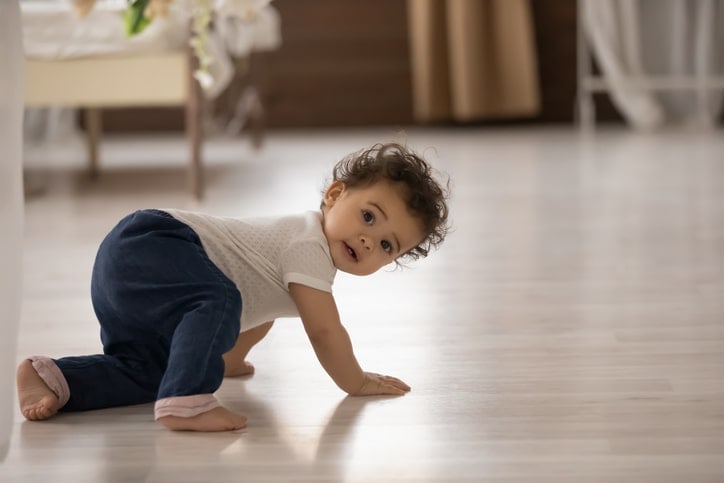
Babies aren't developmentally "programmed" to clamber. Instead, babies are motivated to experiment with different ways of moving, and settle on whatever method seems the most rewarding.
Thus, a infant might choose ane of these styles of crawling:
- abdomen-crawling,
- hands-and-knees itch, or
- hands-and-feet crawling;
or a baby might adopt to move using one of these culling methods:
- bottom-shuffling (also known as "scooting"),
- step-scooting (a kind of tripod shuffle),
- cruising (walking while grasping handholds), or
- rolling,
all of which I describe in detail below. And it's non unusual for a baby to combine several techniques, or improvise his or her ain, quirky fashion of locomotion.
Why so much variety? You might retrieve babies would all converge on the well-nigh efficient, all-time fashion to move from place to place.
Only that's the crux of it: Babies may non concord about what's all-time.
For example, some infants may find crawling too uncomfortable, or adopt a grade of locomotion that permits them to stay in an upright position.
It's also clear that the environment plays a part. As we'll encounter, babies are more likely to crawl when they have been given plenty of opportunities to move freely while lying on their stomachs.
Then let's take a closer look at the development of crawling and other modes of infant locomotion. When do babies crawl, why is there and so much variation, and what can yous expect to run across during your baby's first year?
Here'southward an evidence-based guide, with answers to frequently asked questions about crawling.
How practice babies get started with crawling?
It begins with "tum time," those supervised sessions that your baby spends lying awake on his or her stomach.
During stomach time, babies build up their neck and shoulder muscles. They learn how to hold upwardly their heads and shoulders, supporting themselves with their elbows.
This force and muscle control is essential for itch, but babies don't simply stop there. As infants becomes stronger, they may effort some of these moves:
- doing the "plank" (balancing on arms and feet, or on easily and knees)
- turning in circles (pivoting)
- rocking back and forth on hands and knees
- moving forward a step (either on belly, or on hands and knees)
- shifting dorsum and forth between lying prone and sitting upward
- trying to move forwards, simply pushing backwards instead
Do babies have to chief all of these skills before they begin to crawl?
No. But it'southward likely your baby will practise at least one earlier taking the plunge (Adolf et al 1998).
Do babies have to sit down up before they crawl?
In one case once more, the reply is no. Babies tin can begin belly-crawling before they have achieved this milestone.
Can y'all do anything to help your baby get started?
Yes! Get downwardly on the floor with your baby, and make eye contact. Use smiles and talk to your baby to practice holding his or her head upwards. Every bit your babe gets stronger, encourage your babe to approach you.
And if your baby is struggling to learn the surreptitious of forwards propulsion — trying to movement forward, merely pushing backwards instead — attempt providing some resistance. Place your hands behind your infant's feet, so your infant can button against them.
What's next? For many babies, it'due south abdomen-crawling. Other babies proceed directly to easily-and-knees crawling. And some babies
Styles of crawling
Belly-crawling: The commando crawl and the inchworm crawl
When nosotros retrieve of crawling, we often envision babies scampering around on easily and knees, their tummies held high above the ground. But some babies learn to crawl along on their bellies instead.
Is belly-crawling normal?
Yes, it'southward entirely normal. In fact, when baby locomotion expert Karen Adolf and her colleagues studied the development of crawling in 28 American infants, they constitute that most one-half the infants started their itch careers with some form of abdomen-itch.
When do babies clamber on their bellies?
It varies from baby to babe. In the report by Adolf's squad, well-nigh belly-crawlers began sometime between the ages of 5 and 8.5 months.
What does abdomen-crawling await like?
There are two primary styles:
ane. The regular army clamber, aka "commando crawl." This is easy to identify: A baby, lying prone (belly down), pulls himself forward with her arms, swiveling to the left and right every bit he moves.
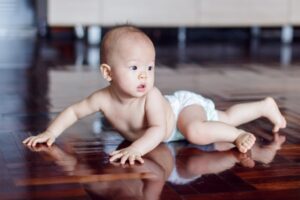
About of the propulsion comes from the upper torso; the legs help a bit, fishtailing from side to side. Just the infant is mostly dragging himself across the floor with his arms and shoulders.
At any given indicate in an army crawl, the baby doesn't have to worry nearly losing his residual. His weight is on his abdomen and thighs.
ii. The "inchworm crawl." In this variant of the belly-clamber, a baby pulls herself frontward with both arms simultaneously, ascension upward slightly and then landing with a belly flop.
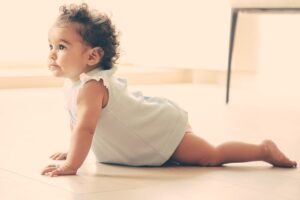
In the rising position, the baby is balanced briefly on her extremities, a bit like someone doing the plank.
Is your baby a commando crawler or an inchworm crawler?
Commando crawling is more common, just information technology'southward not unusual for a infant to do a bit of both. And whichever form of belly-crawling your baby favors, look to see your babe graduate to hands-and-knees crawling (beneath). Belly-crawlers don't remain abdomen-crawlers for long.
What if my infant doesn't belly-crawl?
That's nothing to worry nearly. One-half the babies in Karen Adolf's study skipped belly-crawling birthday, and, as we'll see, information technology's not unusual for babies to employ other methods of locomotion.
Why? If you've ever tried belly-crawling, you know that it'southward very arduous! Depending on the surface and your speed, information technology tin even be painful. Belly flops on the basis can smart. So many babies switch their focus on other motor skills instead.
The classic crawl: Moving on hands-and-knees
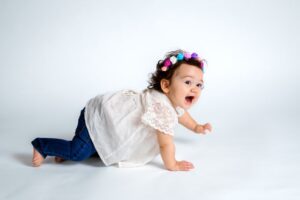
What near classic itch? When exercise babies clamber on their hands and knees?
Some researchers call this "creeping," but I adopt the term "hands-and-knees itch," because it'due south more descriptive of what babies do: Babies balance their weight on easily and knees, keeping their abdomens lifted off the ground.
If your babe has started belly-itch, you can look him or her to switch to hands-and-knees itch inside a couple of months. Only belly-crawling isn't a prerequisite. Some babies begin hands-and-knees crawling without any prior experience with belly-itch.
Any your baby's history, you'll likely see signs before the fateful 24-hour interval. Babies tend to practice balancing get-go, rocking back and along on their easily and knees.
And those first steps?
According to an international study past the World Health Arrangement, babies normally begin hands-and-knees crawling sometime between 6 and xi months, and approximately half of all babies begin itch past 8.3 months (WHO 2006).
Alternatives to archetype crawling: How else exercise babies move from place to place?
As noted above, babies find or invent other methods of locomotion. Here are some of the most common alternatives.
The acquit crawl
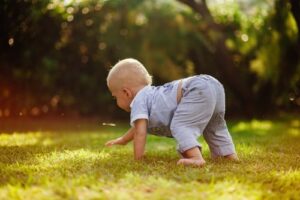
This type of crawling is like hands-and-knees crawling. The baby'southward abdomen is held high, but the babe keeps his or her knees off the ground, balancing instead on easily and anxiety.
The "step-crawl mix"
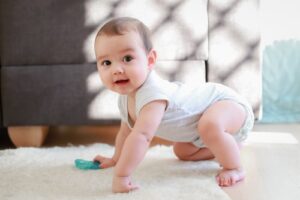
Another approach, sometimes chosen the "step-crawl mix," looks like a bit like a mash-upwardly of easily-and-knees crawling and bear-crawling. Babies crawl on the articulatio genus of 1 leg, while stepping with the foot of the other (Patrick et al 2012).
Bottom-shuffling or scooting
Some babies scoot forth on their bottoms, sitting up and using their legs to power themselves across the floor.
This fashion of movement has been phone call "scooting," "hitching," or "bottom-shuffling," but whatever you call it, the key feature is that the baby'due south lesser bears his or her weight, and the torso is an upright position.
Step-scooting
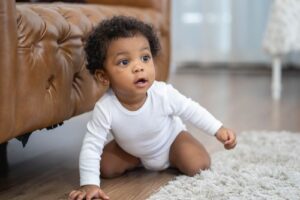
Babies also may motion along tripod-fashion, in a fashion researchers called "step-scooting" (Patrick et al 2012). It looks a picayune like bottom-shuffling, except that babies use one of their arms to aid pull themselves along.
Cruising
Some babies prefer to spend their time learning to "cruise" – to stand up and walk while holding the edges of furniture and other supports.
Rolling
A few babies go from place to place by rolling on their sides.
So at that place isn't any single, right way to movement. Different babies make dissimilar choices, and it's normal for individual babies to employ more than one style of locomotion.
Your baby might alternate between hands-and-knees crawling and bear walking. Or switch back and forth betwixt scooting and some other class of movement (Adolf et al 1998; Patrick et al 2012).
Other questions about crawling
Why do some babies start crawling so much later than others?
1. Trunk type plays a role: Slimmer, lankier babies crawl sooner
It's hard to drag your torso around if you lot're carrying a lot of extra weight! Then leaner babies – who have a more favorable ratio of muscle to trunk fat – have an early on reward.
As Karen Adolf's team noticed in their longitudinal study of crawling, "Smaller, slimmer, more than maturely proportioned infants tended to crawl at before ages than larger, chubbier infants."
2. In add-on, babies crawl earlier when they get lots of "tummy time."
Enquiry confirms that crawling is linked with the amount of waking time babies spend lying on their stomachs. Babies who go lots of "stomach time" and do tend to crawl at an earlier age (Kuo et al 2008; Lobo and Galloway 2012).
3. Motivation matters also.
As noted, belly-itch is grueling work, and hands-and-knees crawling requires a lot of balance control. Some babies may decide it's non worth the trouble, and focus on learning other ways to move.
How soon after crawling practise babies begin to walk?
As yous might expect, it varies.
For instance, in a study of American babies, the average (median) time between the onset of crawling and the onset of walking was approximately four months.
Simply the range was big. One infant remained in the crawling stage for 8.5 months. Some other infant learned to crawl and walk on the same twenty-four hour period (Adolf et al 2011)!
For more than data about walking, see my opens in a new windowParenting Science guide.
Practise babies ever skip crawling and get straight to walking?
Yes, that does happen.
Anthropologist David Tracer notes that there are entire cultures where this is common. Earlier learning to walk, babies in these cultures move effectually by bottom-shuffling. Tracer believes that bottom-shuffling — not crawling — was the style of pre-walking locomotion almost favored by our hunter-gatherer ancestors (Tracer 2009).
Nowadays, in contemporary Western countries, crawling is the norm. Nevertheless, a notable portion of babies in these societies reject crawling in favor of other methods.
For instance, in a recent report tracking the development of 47,000 babies in Norway, researchers plant that nigh seven% of children favored scooting or shuffling, not crawling. Yet these babies learned to walk, just as crawlers did (Storvold et al 2013).
Similarly, a researcher working in the 1980s found that about ix% of British babies preferred to bottom-shuffle. And 7% of babies transitioned to walking without having previously crawled or shuffled (Robson 1984).
Practise parental practices bear upon the development of crawling?
Yes. In societies where parents discourage crawling — or provide infants with less "stomach fourth dimension" — babies are less likely to crawl (Super 1976; Hopkins and Westra 1988; Hogbin 1943).
There's too testify that babies are influenced by cultural practices concerning clothing and the weather.
Consider this historical instance. Dorsum in 1900, crawling was widespread in the United States, simply less prevalent than information technology is today, with approximately forty% of babies using some culling means of locomotion, like bottom-shuffling (Trettian 1900).
Why was itch less common? Karen Adolf thinks it has to do with the long dressing gowns that babies used to wear. "When infants tried to crawl, their knees caught at the border of their long gowns, pinning them in place"(Adolf 2008). Then babies were more than likely to reject crawling in favor of alternative solutions.
Nowadays, long dressing gowns aren't typical, just researchers have noticed an interesting pattern around the world:
In countries with marked seasons, babies tend to crawl earlier if they were born in the winter (Bai 2018).
Why? Such infants achieve the historic period of half dozen months — prime time for learning to clamber — during the summer, when their parents dress them in less restrictive article of clothing, and allow them more than opportunities to play on the ground.
It seems, so, to come up down to very practical considerations. Babies are more probable to crawl when parents make it easy for them to larn the necessary skills.
Why are some babies better at hands-and-knees crawling than others?
Once again, it comes down to do.
When Karen Adolf's team analyzed hands-and-knees crawling, they plant that the speediest, most proficient hands-and-knees crawlers tended to have sure things in common.
Before the onset of hands-and-knees crawling, these babies had racked up more experience with "tummy fourth dimension" skills, including swimming in identify, pivoting effectually in circles on their stomachs, and rocking back and forth on hands and knees.
In addition, babies who had a history of abdomen-crawling had an advantage: From the very first days that they adopted hands-and-knees crawling, they were faster and more efficient (Adolf et al 1998).
So all that hard work pays off. If you train like a marine, yous will have a head start with hands-and-knees crawling.
If a baby doesn't crawl, will he or she exist any slower to attain the milestone of walking?
Perhaps, merely research suggests in won't make much deviation in the long-run. And in some cases, babies who skip crawling actually end up walking sooner.
For instance, in the Norwegian report, the scooting, shuffling babies took an boilerplate of 3.5 weeks longer to have their first, independent steps (Storvold et al 2013). Likewise, the British study establish that bottom-shufflers walked at a slightly later on age (Robson 1984).
Withal the earliest walkers in the British study were the ones who began walking without having been observed to engage in whatever prior form of locomotion, a finding replicated past a pocket-sized study of Turkish children (Cimbiz and Bayazit 2005).
When should I worry?
As we've seen, information technology's normal for some babies to reject crawling in favor of other modes of locomotion. So you shouldn't worry merely considering your baby isn't crawling.
Every bit long as your infant shows progress over fourth dimension — developing means of moving from place to place — you should feel reassured that your infant's skills are on track.
But if your baby isn't making progress with whatsoever sort of locomotion by the historic period of 12 months — or shows bear witness of weakness or poor control on one side of the body — talk with your pediatrician.
And remember: Y'all should always consult your pediatrician if something doesn't feel correct. If there is a trouble, early intervention can aid go your babe back on track.
Wondering when your babe will begin walking? And what stages of evolution to sentinel for?
Be sure to check out my article, "When practice babies start walking?"
This commodity explains:
- signs that your babe volition brainstorm walking shortly
- stages of learning to walk
- the timing of (one) learning to walk with back up; and (2) learning to walk independently
- cultural and parenting factors that can speed up (or dull downward the process)
More than evidence-based data about babies
Yous tin can read more nearly your baby's development in this opens in a new windowParenting Science guide.
References: When do babies clamber?
Adolph KE, Berger SE, Leo AJ. 2011. Developmental continuity? Crawling, cruising, and walking. Dev Sci. fourteen(2):306-18
Adolph KE, Cole WG, Komati One thousand, Garciaguirre JS, Badaly D, Lingeman JM, Chan GL, Sotsky RB. 2012. How do you learn to walk? Thousands of steps and dozens of falls per day. Psychol Sci. 23(eleven):1387-94
Adolph KE, Vereijken B, Denny MA. 1998. Learning to crawl. Child Dev. 1998 Oct;69(5):1299-312.
Bai Y, Shang G, Wang L, Lord's day Y, Osborn A, Rozelle S. 2018. The relationship betwixt birth season and early childhood evolution: Prove from northwest rural China. PLoS One. 13(10):e0205281.
Bottos Chiliad, Dalla Barba B, Stefani D, Pettenà One thousand, Tonin C, D'Este A. 1989. Locomotor strategies preceding independent walking: prospective study of neurological and language evolution in 424 cases. Dev Med Kid Neurol. 31(1):25-34.
Cimbiz A and Bayazit V. 2005. Effects of infant crawling experience on range of motility. Neurosciences x (i): 34-40.
Hogbin Hi. 1943. A New Guinea infancy: From conception to weaning in Wogeo. Oceania 13: 285-309.
Hopkins B and Westra T. 1988. Maternal treatment and motor development: an intracultural written report. Genet Soc Gen Psychol Monogr. 114(3):377-408.
Karasik LB, Tamis-LeMonda CS, Adolph KE. 2011. Transition from itch to walking and infants' actions with objects and people. Child Dev. 82(4):1199-209.
Kretch KS, Franchak JM, Adolph KE. 2014. Crawling and walking infants see the globe differently. Child Dev. 85(4):1503-18.
Kuo YL, Liao HF, Chen PC, Hsieh WS, Hwang AW. 2008. The influence of wakeful prone positioning on motor development during the early life. J Dev Behav Pediatr. 29(five):367-76.
Lobo MA and Galloway JC. 2012. Enhanced handling and positioning in early infancy advances development throughout the kickoff year. Kid Dev. 83(4):1290-302
Patrick SK, Noah JA, Yang JF. 2012. Developmental constraints of quadrupedal coordination across crawling styles in human infants. J Neurophysiol. 107(11):3050-61.
Robson P. 1984. Prewalking locomotor movements and their utilize in predicting standing and walking. Child Care Health Dev. 198410(5):317-30.
Størvold GV, Aarethun K, Bratberg GH. 2013. Age for onset of walking and prewalking strategies. Hum Dev. 89(9):655-9.
Super CM. 1976. Environmental furnishings on motor development: the instance of "African infant precocity". Dev Med Child Neurol. eighteen(v):561-vii.
Tracer DP. 2009. Babe carrying and prewalking locomotor development: proximate and evolutionary perspectives. Proceedings of the 78th Annual Meeting of the American-Association-of-Physical-Anthropologists; Chicago, IL.
Trettien AW. 1900. Creeping and walking. The American Journal of Psychology. 12:i–57.
WHO Multicentre Growth Reference Written report Grouping. 2006. WHO Motor Development Study: windows of achievement for half dozen gross motor development milestones. Acta Paediatr Suppl. 450:86-95.
Content of "When practise babies crawl?" last modified 3/25/2020
Image and video credits for "When do babies clamber?"
title image of infant looking over shoulder while trying to crawl past fizkes / istock
paradigm of baby commando crawling by Yaoinlove / istock
epitome of baby inchworm crawling by MangoStar_Studio / istock
image of baby with flowers in hair itch on hands and knees by JBrownInTheLight / istock
image of babe "bear crawling" by shevtsovy / shutterstock
epitome of baby step-cawl mix by opens in a new window Onjira Leibe / shutterstock
youtube video clip of babe bottom-shuffling by Mal Chia
image of baby next to couch step-scooting by RONNACHAIPARK / shutterstock
Source: https://parentingscience.com/when-do-babies-crawl/
0 Response to "Baby Emotional Crying Baby 5 Physical Learning How to Swim"
Post a Comment