What Is a Normal Reading on a Blood Glucose Meter?
| Glucose meter | |
|---|---|
 Four generations of claret glucose meter, c. 1993–2005. Sample sizes vary from thirty to 0.3 μl. Test times vary from 5 seconds to 2 minutes (modern meters typically provide results in v seconds). | |
| Purpose | measure concentration of glucose in the claret |
A glucose meter, also referred to as a "glucometer",[1] is a medical device for determining the gauge concentration of glucose in the blood. It can besides be a strip of glucose paper dipped into a substance and measured to the glucose chart. It is a fundamental chemical element of dwelling blood glucose monitoring (HBGM) by people with diabetes mellitus or hypoglycemia. A small drib of blood, obtained by pricking the skin with a lancet, is placed on a disposable examination strip that the meter reads and uses to summate the blood glucose level. The meter then displays the level in units of mg/dL or mmol/Fifty.
Since approximately 1980, a primary goal of the management of type one diabetes and type 2 diabetes mellitus has been achieving closer-to-normal levels of glucose in the blood for equally much of the fourth dimension as possible, guided by HBGM several times a twenty-four hour period. The benefits include a reduction in the occurrence charge per unit and severity of long-term complications from hyperglycemia likewise equally a reduction in the short-term, potentially life-threatening complications of hypoglycemia.
History [edit]
Leland Clark presented his first paper almost the oxygen electrode, later named the Clark electrode, on 15 April 1956, at a meeting of the American Society for Artificial Organs during the annual meetings of the Federated Societies for Experimental Biology.[two] [iii] In 1962, Clark and Ann Lyons from the Cincinnati Children's Hospital developed the first glucose enzyme electrode. This biosensor was based on a thin layer of glucose oxidase (GOx) on an oxygen electrode. Thus, the readout was the amount of oxygen consumed by GOx during the enzymatic reaction with the substrate glucose. This publication became one of the most often cited papers in life sciences. Due to this piece of work he is considered the "male parent of biosensors," peculiarly with respect to the glucose sensing for diabetes patients.[4] [5]

CDC image showing the usage of a lancet and a claret glucose meter
Some other early glucose meter was the Ames Reflectance Meter by Anton H. Clemens. It was used in American hospitals in the 1970s. A moving needle indicated the blood glucose after most a minute.
Home glucose monitoring was demonstrated to improve glycemic control of type one diabetes in the late 1970s, and the first meters were marketed for home utilise around 1981. The two models initially ascendant in North America in the 1980s were the Glucometer, introduced in November 1981,[6] whose trademark is owned past Bayer, and the Accu-Chek meter (by Roche). Consequently, these brand names accept go synonymous with the generic product to many wellness care professionals. In Britain, a health care professional or a patient may refer to "taking a BM": "Mrs Ten'south BM is five", etc. BM stands for Boehringer Mannheim, now part of Roche, who produce test strips called 'BM-test' for employ in a meter.[seven] [eight]
In North America, hospitals resisted adoption of meter glucose measurements for inpatient diabetes care for over a decade. Managers of laboratories argued that the superior accuracy of a laboratory glucose measurement outweighed the advantage of immediate availability and fabricated meter glucose measurements unacceptable for inpatient diabetes management. Patients with diabetes and their endocrinologists eventually persuaded acceptance. Some health care policymakers yet resist the idea that the club would be well advised to pay the consumables (reagents, lancets, etc.) needed.[ citation needed ]
Home glucose testing was adopted for blazon two diabetes more slowly than for type ane, and a large proportion of people with type 2 diabetes take never been instructed in home glucose testing.[nine] This has mainly come up about because health authorities are reluctant to bear the cost of the test strips and lancets.
Not-meter exam strips [edit]
Test strips that changed colour and could exist read visually, without a meter, have been widely used since the 1980s. They had the added advantage that they could be cut longitudinally to save money. Critics argued that test strips read by eye are not as authentic or user-friendly as meter testing. The manufacturer cited studies that show the production is just as effective despite not giving an answer to 1 decimal place, something they argue is unnecessary for control of blood saccharide. This debate as well happened in Frg where "Glucoflex-R" was an established strip for type 2 diabetes. As meter accurateness and insurance coverage improved, they lost popularity.
"Glucoflex-R" is Commonwealth of australia manufacturer National Diagnostic Products culling to the BM test strip. It has versions that can be used either in a meter or read visually. It is also marketed under the brand proper name Betachek. On May one, 2009, the U.k. benefactor Ambe Medical Group reduced the cost of their "Glucoflex-R" test strip to the NHS, past approximately l%. This was expected to allow the NHS to save money on strips and mayhap loosen the restrictions on supply a piffling. Another low cost visually read strip is presently to be bachelor on prescription according to sources at the NHS.[ when? ]
Types of meters [edit]
Hospital glucose meters [edit]
Special glucose meters for multi-patient hospital use are at present used. These provide more elaborate quality control records. Their data handling capabilities are designed to transfer glucose results into electronic medical records and the laboratory calculator systems for billing purposes.
Blood testing with meters using exam strips [edit]
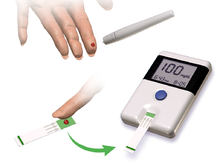
Analogy depicting glucose monitoring with glucometer

Illustration depicting glucose meter and exam strips
In that location are several key characteristics of glucose meters which may differ from model to model:
- Size: The average size is now approximately the size of the palm of the hand, although hospital meters can exist the size of a remote control. They are bombardment-powered.
- Examination strips: A consumable element containing chemicals that react with glucose in the drop of blood is used for each measurement. For some models this element is a plastic test strip with a minor spot impregnated with glucose oxidase and other components. Each strip is used once and then discarded. Instead of strips, some models use discs, drums, or cartridges that contain the consumable material for multiple tests.
-
- Coding: Since test strips may vary from batch to batch, some models require the user to manually enter in a code found on the vial of exam strips or on a chip that comes with the test strip. By entering the coding or chip into the glucose meter, the meter volition be calibrated to that batch of test strips. However, if this process is carried out incorrectly, the meter reading can be up to four mmol/Fifty (72 mg/dL) inaccurate. The implications of an incorrectly coded meter can exist serious for patients actively managing their diabetes. This may place patients at increased adventure of hypoglycemia. Alternatively, some examination strips contain the lawmaking information in the strip; others accept a microchip in the vial of strips that can be inserted into the meter. These last two methods reduce the possibility of user error. I Impact has standardized their test strips around a single code number, so that, one time ready, there is no need to further alter the code in their older meters, and in some of their newer meters, there is no mode to modify the code.
- Volume of blood sample: The size of the drib of blood needed by different models varies from 0.3 to ane μl. (Older models required larger blood samples, usually defined equally a "hanging drib" from the fingertip.) Smaller book requirements reduce the frequency of unproductive pricks.
- Alternate site testing: Smaller driblet volumes have enabled "alternate site testing" – pricking the forearms or other less sensitive areas instead of the fingertips. This type of testing should only be used when blood glucose levels are stable, such as when before meals, when fasting, or simply before going to sleep.[10]
- Testing times: The times it takes to read a test strip may range from 3 to 60 seconds for different models.
- Brandish: The glucose value in mg/dl or mmol/l is displayed on a digital display. The preferred measurement unit of measurement varies by country: mg/dl are preferred in the US, French republic, Japan, Israel, and India. mmol/fifty are used in Canada, Australia and China. Germany is the just state where medical professionals routinely operate in both units of measure. (To convert mmol/50 to mg/dl, multiply past eighteen. To convert mg/dl to mmol/50, divide past 18.) Many meters can brandish either unit of mensurate; there have been a couple of published instances[ citation needed ] in which someone with diabetes has been misled into the incorrect action past assuming that a reading in mmol/50 was really a very depression reading in mg/dl, or the converse. In general, if a value is presented with a decimal betoken, it is in mmol/l, without a decimal it is most likely mg/dl.
Table of blood glucose units of measurement by state [eleven]
| |||||
|---|---|---|---|---|---|
| Country | Unit of measurement used | Country | Unit of measurement used | ||
| Algeria | mg/dL | Malaysia | mmol/L | ||
| Argentina | mg/dL | Republic of malta | mmol/Fifty | ||
| Australia | mmol/L | Mexico | mg/dL | ||
| Austria | mg/dL | Netherlands | mmol/L | ||
| Bahrain | mg/dL | New Zealand | mmol/Fifty | ||
| Bangladesh | mg/dL | Norway | mmol/L | ||
| Belgium | mg/dL | Sultanate of oman | mg/dL | ||
| Brazil | mg/dL | Peru | mg/dL | ||
| Canada | mmol/L | Philippines | mg/dL | ||
| Caribbean countries | mg/dL | Poland | mg/dL | ||
| Chile | mg/dL | Portugal | mg/dL | ||
| People's republic of china | mmol/Fifty | Qatar | mmol/L | ||
| Colombia | mg/dL | Russian federation | mmol/L | ||
| Czech Republic | mmol/L | Saudi arabia | mg/dL | ||
| Denmark | mmol/50 | Singapore | mmol/L | ||
| Ecuador | mg/dL | Slovakia | mmol/L | ||
| Egypt | mg/dL | South Africa | mmol/L | ||
| Finland | mmol/L | Spain | mg/dL | ||
| France | mg/dL | Sub-Saharan Africa | mg/dL mmol/L | ||
| Georgia | mg/dL | Sweden | mmol/L | ||
| Federal republic of germany | mg/dL mmol/L | Switzerland | mmol/L | ||
| Greece | mg/dL | Syria | mg/dL | ||
| Hong Kong | mmol/50 | Taiwan | mg/dL | ||
| India | mg/dL | Thailand | mg/dL | ||
| Indonesia | mg/dL | Tunisia | mg/dL | ||
| Ireland | mmol/Fifty | Turkey | mg/dL | ||
| Israel | mg/dL | Ukraine | mmol/L | ||
| Italian republic | mg/dL | United Arab Emirates (UAE) | mg/dL | ||
| Japan | mg/dL | United Kingdom | mmol/50 | ||
| Jordan | mg/dL | U.s.a. | mg/dL | ||
| Kazakhstan | mmol/L | Uruguay | mg/dL | ||
| Korea | mg/dL | Venezuela | mg/dL | ||
| Kuwait | mg/dL | Vietnam | mmol/L | ||
| Lebanon | mg/dL | Yemen | mg/dL | ||
| Luxembourg | mg/dL | ||||

-
- Glucose vs. plasma glucose: Glucose levels in plasma (one of the components of claret) are higher than glucose measurements in whole blood; the divergence is well-nigh 11% when the hematocrit is normal. This is important considering home blood glucose meters measure the glucose in whole blood while most lab tests measure the glucose in plasma. Currently, at that place are many meters on the market place that give results equally "plasma equivalent," even though they are measuring whole blood glucose. The plasma equivalent is calculated from the whole blood glucose reading using an equation congenital into the glucose meter. This allows patients to hands compare their glucose measurements in a lab test and at dwelling house. It is of import for patients and their health care providers to know whether the meter gives its results as "whole claret equivalent" or "plasma equivalent." One model measures beta-hydroxybutyrate in the blood to detect ketosis for measuring both unhealthy ketoacidosis and healthy nutritional ketosis.
- Clock/retentiveness: Most meters at present include a clock that is set by the user for date and time and a retentivity for past exam results. The memory is an important attribute of diabetes care, as information technology enables the person with diabetes to continue a tape of management and expect for trends and patterns in blood glucose levels over days and weeks. Most memory fries can brandish an boilerplate of contempo glucose readings. A known deficiency of all current meters is that the clock is often non set to the correct time (i.e., due to time changes, static electricity, etc.) and therefore has the potential to misrepresent the time of the past test results making pattern direction difficult.
-
- Data transfer: Many meters at present accept more sophisticated information treatment capabilities. Many tin can be downloaded past a cablevision or infrared to a calculator that has diabetes management software to display the test results. Some meters allow information transfer to smartphones using Bluetooth applied science, where an app tin can be used to monitor readings over time. Some meters allow entry of additional data throughout the twenty-four hour period, such equally insulin dose, amounts of carbohydrates eaten, or practise. A number of meters have been combined with other devices, such every bit insulin injection devices, PDAs, cellular transmitters,[12] and Game Boys.[thirteen] A radio link to an insulin pump allows automatic transfer of glucose readings to a calculator that assists the wearer in deciding on an advisable insulin dose.
Toll [edit]
The cost of home blood glucose monitoring can be substantial due to the toll of the examination strips. In 2006, the consumer cost of each glucose strip ranged from about $0.35 to $i.00. Manufacturers oft provide meters at no price to induce use of the assisting test strips. Type one diabetics may test as oft as 4 to ten times a day due to the dynamics of insulin adjustment, whereas type 2 typically examination less oft, especially when insulin is non part of handling. A recent report on the comparative price-effectiveness of all options for the self-monitoring of blood glucose funded by the National Wellness Service in the Britain uncovered considerable variation in the toll paid, which could not be explained past the availability of advanced meter features. It estimated that a total of £12 m was invested in providing 42 million self-monitoring of claret glucose tests with systems that fail to meet acceptable accuracy standards, and efficiency savings of £23.2 m per annum are achievable if the National Wellness Service were to disinvest from technologies providing bottom functionality than available alternatives, but at a much college price.[14] Batches of counterfeit exam strips for some meters have been identified, which have been shown to produce inaccurate results.[15]
Noninvasive meters [edit]
The search for a successful technique began near 1975 and has continued to the present without a clinically or commercially feasible product.[sixteen] Equally of 1999[update], just one such product had ever been approved for sale by the FDA, based on a technique for electrically pulling glucose through intact skin, and it was withdrawn after a brusk time owing to poor operation and occasional harm to the pare of users.[17]
Continuous glucose monitors [edit]
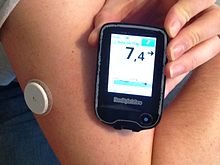
Continuous glucose monitor. The sensor and transmitter are fixed to the upper arm. The reader shows days to replacement of sensor, electric current blood glucose level and a diagram of the latest blood glucose levels.
Continuous glucose monitor systems can consist of a disposable sensor placed under the skin, a transmitter continued to the sensor and a reader that receives and displays the measurements. The sensor tin can be used for several days before information technology needs to be replaced. The devices provide real-time measurements, and reduce the need for fingerprick testing of glucose levels. A drawback is that the meters are not equally accurate because they read the glucose levels in the interstitial fluid which lags behind the levels in the blood.[18] [nineteen] Continuous blood glucose monitoring systems are also relatively expensive.
Accuracy [edit]
Accuracy of glucose meters is a common topic of clinical business. Claret glucose meters must meet accurateness standards prepare by the International Organization for Standardization (ISO). According to ISO 15197 Claret glucose meters must provide results that are inside ±15% of a laboratory standard for concentrations to a higher place 100 mg/dL or within ±fifteen mg/dL for concentrations below 100 mg/dL at least 95% of the time.[20] Yet, a variety of factors can affect the accuracy of a test. Factors affecting accuracy of various meters include calibration of meter, ambience temperature, force per unit area use to wipe off strip (if applicable), size and quality of blood sample, loftier levels of certain substances (such as ascorbic acid) in claret, hematocrit, dirt on meter, humidity, and crumbling of exam strips. Models vary in their susceptibility to these factors and in their ability to forbid or warn of inaccurate results with mistake messages. The Clarke Mistake Grid has been a common way of analyzing and displaying accuracy of readings related to management consequences. More recently an improved version of the Clarke Error Grid has come into utilise: Information technology is known as the Consensus Error Filigree. Older blood glucose meters often need to be "coded" with the lot of test strips used, otherwise, the accuracy of the claret glucose meter may exist compromised due to lack of calibration.
Future [edit]
| | Parts of this commodity (those related to the Hereafter department) need to be updated. (November 2017) |
One noninvasive glucose meter has been approved by the U.S. FDA: The GlucoWatch G2 Biographer made by Cygnus Inc. The device was designed to be worn on the wrist and used electric fields to depict out body fluid for testing. The device did not replace conventional blood glucose monitoring. One limitation was that the GlucoWatch was not able to cope with perspiration at the measurement site. Sweat must be allowed to dry earlier measurement tin resume. Due to this limitation and others, the product is no longer on the market.
The market introduction of noninvasive blood glucose measurement by spectroscopic measurement methods, in the field of near-infrared (NIR), by extracorporal measuring devices, has not been successful because the devices measure tissue sugar in body tissues and non the blood sugar in claret fluid. To determine claret glucose, the measuring beam of infrared calorie-free, for instance, has to penetrate the tissue for measurement of blood glucose.
There are currently 3 CGMS (continuous glucose monitoring arrangement) bachelor. The first is Medtronic's Minimed Paradigm RTS with a sub-cutaneous probe attached to a small transmitter (roughly the size of a quarter) that sends interstitial glucose levels to a small pager sized receiver every v minutes. The Dexcom System is some other system, available in 2 different generations in the US, the G4 and the G5. (1Q 2016). Information technology is a hypodermic probe with a small transmitter. The receiver is about the size of a cell telephone and can operate up to 20 feet from the transmitter. The Dexcom G4 transmits via radio frequency and requires a defended receiver.[21] The G5 version utilizes Bluetooth low free energy for data transmission, and can transmit information directly to a compatible cellular telephone. Currently, merely Apple'due south iPhone can exist used equally a receiver,[22] but Dexcom is in the process of getting an Android version approved, and anticipates availability in the second half of 2016. Aside from a two-hour scale period, monitoring is logged at five-minute intervals for up to 1 week. The user tin set up the high and low glucose alarms. The third CGMS available is the FreeStyle Navigator from Abbott Laboratories.
There is currently an endeavor to develop an integrated treatment system with a glucose meter, insulin pump, and wristop controller, equally well equally an effort to integrate the glucose meter and a cell phone. These glucose meter/cellular phone combinations are under testing and currently cost The states$149 retail.[ when? ] Testing strips are proprietary and available only through the manufacturer (no insurance availability). These "Glugophones" are currently offered in three forms: as a dongle for the iPhone, an add-on pack for LG model UX5000, VX5200, and LX350 cell phones, as well as an add-on pack for the Motorola Razr cell phone. In US, this limits providers to AT&T and Verizon. Like systems have been tested for a longer time in Finland.[ citation needed ]
Contempo advances in cellular data communications applied science accept enabled the development of glucose meters that direct integrate cellular data transmission capability, enabling the user to both transmit glucose data to the medical caregiver and receive direct guidance from the caregiver on the screen of the glucose meter. The showtime such device, from Telcare, Inc., was exhibited at the 2010 CTIA International Wireless Expo,[23] where information technology won an East-Tech honour. This device then underwent clinical testing in the Us and internationally.
In early 2014 Google reported testing prototypes of contact lenses that monitor glucose levels and alert users when glucose levels cantankerous certain thresholds.[24] [25] [26]
Engineering science [edit]
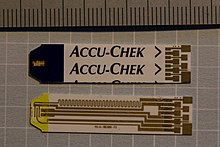
2 used Accu-Chek exam strips. The lower one has had the cover peeled off to testify the circuit.
Many glucose meters employ the oxidation of glucose to gluconolactone catalyzed past glucose oxidase (sometimes known equally GOx). Others employ a similar reaction catalysed instead by some other enzyme, glucose dehydrogenase (GDH). This has the advantage of sensitivity over glucose oxidase merely is more than susceptible to interfering reactions with other substances.[27]
The first-generation devices relied on the aforementioned colorimetric reaction that is still used nowadays in glucose examination strips for urine. As well glucose oxidase, the test kit contains a benzidine derivative, which is oxidized to a blue polymer by the hydrogen peroxide formed in the oxidation reaction. The disadvantage of this method was that the test strip had to be developed later a precise interval (the blood had to be washed abroad), and the meter needed to be calibrated frequently.
Well-nigh glucometers today use an electrochemical method. Test strips contain a capillary that sucks up a reproducible amount of claret. The glucose in the blood reacts with an enzyme electrode containing glucose oxidase (or dehydrogenase). The enzyme is reoxidized with an excess of a mediator reagent, such every bit a ferricyanide ion, a ferrocene derivative or osmium bipyridyl complex. The mediator in turn is reoxidized by reaction at the electrode, which generates an electrical current. The total charge passing through the electrode is proportional to the amount of glucose in the claret that has reacted with the enzyme. The coulometric method is a technique where the total amount of charge generated by the glucose oxidation reaction is measured over a period of fourth dimension. The amperometric method is used by some meters and measures the electric electric current generated at a specific bespeak in time by the glucose reaction. This is analogous to throwing a brawl and using the speed at which information technology is travelling at a signal in time to estimate how difficult it was thrown. The coulometric method tin can allow for variable test times, whereas the test time on a meter using the amperometric method is ever stock-still. Both methods give an estimation of the concentration of glucose in the initial claret sample.
The aforementioned principle is used in examination strips that accept been commercialized for the detection of diabetic ketoacidosis (DKA). These examination strips use a beta-hydroxybutyrate-dehydrogenase enzyme instead of a glucose oxidizing enzyme and take been used to detect and help treat some of the complications that can upshot from prolonged hyperglycemia.[28]
Claret alcohol sensors using the aforementioned approach, but with alcohol dehydrogenase enzymes, have been tried and patented but have not yet been successfully commercially adult.
Meter use for hypoglycemia [edit]
Although the apparent value of immediate measurement of blood glucose might seem to be higher for hypoglycemia than hyperglycemia, meters accept been less useful. The primary problems are precision and ratio of fake positive and negative results. An imprecision of ±15% is less of a trouble for loftier glucose levels than low. There is footling deviation in the direction of a glucose of 200 mg/dl compared with 260 (i.east., a "true" glucose of 230±15%), but a ±xv% error margin at a low glucose concentration brings greater ambiguity with regards to glucose management.
The imprecision is compounded by the relative likelihoods of false positives and negatives in populations with diabetes and those without. People with blazon 1 diabetes usually have a wider range of glucose levels, and glucose peaks higher up normal, frequently ranging from 40 to 500 mg/dl (2.2 to 28 mmol/fifty), and when a meter reading of 50 or 70 (ii.8 or iii.nine mmol/l) is accompanied by their usual hypoglycemic symptoms, there is footling uncertainty almost the reading representing a "truthful positive" and little harm washed if information technology is a "false positive." However, the incidence of hypoglycemia unawareness, hypoglycemia-associated autonomic failure (HAAF) and faulty counterregulatory response to hypoglycemia make the demand for greater reliability at low levels peculiarly urgent in patients with type 1 diabetes mellitus, while this is seldom an upshot in the more mutual form of the disease, type 2 diabetes mellitus.
In dissimilarity, people who do not have diabetes may periodically have hypoglycemic symptoms but may also have a much higher rate of false positives to true, and a meter is not authentic plenty to base a diagnosis of hypoglycemia upon. A meter can occasionally be useful in the monitoring of severe types of hypoglycemia (due east.g., congenital hyperinsulinism) to ensure that the average glucose when fasting remains above 70 mg/dl (three.9 mmol/50).
See also [edit]
- ISO/IEEE 11073
References [edit]
- ^ "Definition of GLUCOMETER". www.merriam-webster.com . Retrieved 2020-10-ten .
- ^ Advances in Electrochemical Sciences and Engineering : Bioelectrochemistry : Fundamentals, Applications and Recent Developments. Somerset, NJ, U.s.: John Wiley & Sons, 2013.
- ^ Lipkowski, J., Kolb, D. M., & Alkire, R. C. (2011). Bioelectrochemistry : Fundamentals, Applications and Contempo Developments. Weinheim: Wiley-VCH.
- ^ Advances in Electrochemical Sciences and Applied science : Bioelectrochemistry : Fundamentals, Applications and Contempo Developments. Somerset, NJ, US: John Wiley & Sons, 2013.
- ^ Lipkowski, J., Kolb, D. Yard., & Alkire, R. C. (2011). Bioelectrochemistry : Fundamentals, Applications and Contempo Developments. Weinheim: Wiley-VCH.
- ^ "Portable Meter To Aid Diabetics", Pittsburgh Printing, November 5, 1981, p. A-6
- ^ "Insulin Pumpers UK: Glossary". Insulin-pumpers.org.uk. Retrieved 2014-03-13 .
- ^ "Diabetic Seniors – Advisory Resource for Seniors with Diabetes". Diabetes-wise.net. Archived from the original on 2014-xi-08. Retrieved 2014-03-13 .
- ^ "Diabetes Great britain, UK Diabetes Resource, Diabetes Symptoms, Diabetes Diet, Gestational Diabetes". Diabetes.co.uk. Retrieved 2014-03-13 .
- ^ "Alternating site testing". Accu-Chek.com. Retrieved 2018-07-twenty .
- ^ "Home | Freestyle". Abbottdiabetescare.com.au. 2013-08-xiii. Archived from the original on Feb 19, 2011. Retrieved 2014-03-13 .
- ^ "Print Diabetes Self-Management". Diabetesselfmanagement.com. Retrieved 2014-03-thirteen .
- ^ "Diabetes In Control : Newsletter" (PDF). Diabetesincontrol.com. Retrieved 2014-03-13 .
- ^ Leigh, Simon; Idris, Iskandar; Collins, Brendan; Granby, Paul; Noble, Max; Parker, Marking (Nov 2015). "Promoting wellness and reducing costs: a role for reform of self-monitoring of blood glucose provision inside the National Health Service". Diabetic Medicine. 33 (5): 681–ninety. doi:10.1111/dme.12977. PMID 26443548. S2CID 19190997.
- ^ "Artificial Diabetes Test Strips Traced to Chinese Distributor". The New York Times . Retrieved 2014-03-13 .
- ^ The Pursuit of Noninvasive Glucose, 3rd Edition, past John Fifty. Smith, Ph.D., available at http://www.mendosa.com/The%20Pursuit%20of%20Noninvasive%20Glucose%203rd%20Edition.pdf.
- ^ Tamada JA, Garg S, Jovanovic L, Pitzer KR, Fermi S, Potts RO (November 1999). "Noninvasive glucose monitoring: comprehensive clinical results. Cygnus Research Team". JAMA. 282 (xix): 1839–44. doi:10.1001/jama.282.19.1839. PMID 10573275.
- ^ "Continuous Glucose Monitoring". The National Institute of Diabetes and Digestive and Kidney Diseases. Dec 2008. Retrieved 21 Feb 2016.
- ^ "FreeStyle Libre". Abbott Laboratories. Retrieved 21 Feb 2016. An example of a CGM
- ^ Freckmann, Thou; Schmid, C; Baumstark, A; Rutschmann, 1000; Haug, C; Heinemann, L (July 2015). "Analytical Performance Requirements for Systems for Self-Monitoring of Blood Glucose With Focus on System Accuracy: Relevant Differences Amongst ISO 15197:2003, ISO 15197:2013, and Electric current FDA Recommendations". Journal of Diabetes Scientific discipline and Technology. nine (4): 885–94. doi:10.1177/1932296815580160. PMC4525642. PMID 25872965.
- ^ "Dexcom G4 product website". Retrieved 2016-01-30 .
- ^ "Dexcom Product Compatibility". Retrieved 2016-01-30 .
- ^ "CTIA International Wireless 2010 Finds Telcare Inc. Measures Up to Emerging Engineering science Award for Cellular-enabled Blood Glucose Meter Solution". Eworldwire. 2010-03-25. Retrieved 2014-03-thirteen .
- ^ NM Farandos; AK Yetisen; MJ Monteiro; CR Lowe; SH Yun (2014). "Contact Lens Sensors in Ocular Diagnostics". Avant-garde Healthcare Materials. 4 (6): 792–810. doi:10.1002/adhm.201400504. PMID 25400274.
- ^ Lardinois, Frederic (January 16, 2014). "Google Unveils Smart Contact Lens That Lets Diabetics Mensurate Their Glucose Levels". TechCrunch . Retrieved January 17, 2014.
- ^ Mendoza, Martha (January 16, 2014). "Google develops contact lens glucose monitor". Associated Press. Retrieved January 17, 2014.
- ^ "How Do Blood-Glucose Meters Work?". Archived from the original on 4 March 2016. Retrieved 28 November 2012.
- ^ Ghoshdastider U, Wu R, Trzaskowski B, Mlynarczyk Thousand, Miszta P, Gurusaran G, Viswanathan S, Renugopalakrishnan V, Filipek S (2015). "Nano-Encapsulation of Glucose Oxidase Dimer by Graphene". RSC Advances. 5 (xviii): 13570–78. doi:10.1039/C4RA16852F.
{{cite journal}}: CS1 maint: uses authors parameter (link)
Source: https://en.wikipedia.org/wiki/Glucose_meter
0 Response to "What Is a Normal Reading on a Blood Glucose Meter?"
Post a Comment